
Learn · for parents
Where to hit: the simple singles strategy every junior should know

Coach ArthurHead Pro, Concord Tennis Academy · Toronto, Canada · 20+ years coaching · 8 min read
In singles, hit into the big empty space, away from your opponent. Rally on the diagonal, which coaches call cross-court. Change direction only when the ball is short and high and your child is there early.
These ideas come from our Tennis Thinking lessons, from the first lesson to the advanced ones. If a 9-year-old can say the plan out loud, they can use it in a match.
Three words you'll see below:
- Cross-court: hitting diagonally, from your corner of the court to the opposite corner.
- Down the line: hitting straight ahead, along the side of the court.
- Baseline and service line: the baseline is the back line of the court. The service line is the line across the middle of each side, where the service boxes end.
1. Hit where they aren't
A ball hit straight at the other player is easy for them, even a hard one. They don't have to move, so they have time to set up and choose their shot. A ball to the empty side makes them run.
Aim at the space, not the line. The line is the smallest target on the court. Aiming there means a small miss is out. Aim for the big empty area inside the lines, and a small miss is still in.
2. Rally cross-court
When neither player has an easy ball, the safe choice is cross-court. There are two reasons, and both come from the official size of the court in the ITF Rules of Tennis.
The net is lower in the middle. It is 3 feet (0.914 m) high in the middle and 3½ feet (1.07 m) at the posts. A cross-court ball crosses near the middle. A ball hit near the posts has up to 15 cm (6 inches) less room.
The court is longer on the diagonal. A singles court is 23.77 m long and 8.23 m wide. From one corner to the opposite corner is about 25.2 m. So a cross-court ball can have up to about 1.4 m (4½ feet) more court to land in. Your child doesn't need to hit the corner to get some of that room.
Lower net, more court: that's room to miss and still be in. Down the line is a fine shot. It's just a shot for the right ball, not for every ball of the rally.
3. Pull them wide, then use the space
The pattern I teach juniors most is two shots long.
- Shot 1 pulls the opponent wide. A cross-court ball does this well, because the diagonal can go wider than any other shot.
- Shot 2 goes to the side they just left. That side is now empty.
How far to go with shot 2 depends on how far they were pulled. If the opponent is pulled very wide and deep, a short diagonal to the other side (one that lands near the side of the service box) can be best. If they weren't pulled far, a deep ball to the other side is usually better.
4. Change direction on the right ball
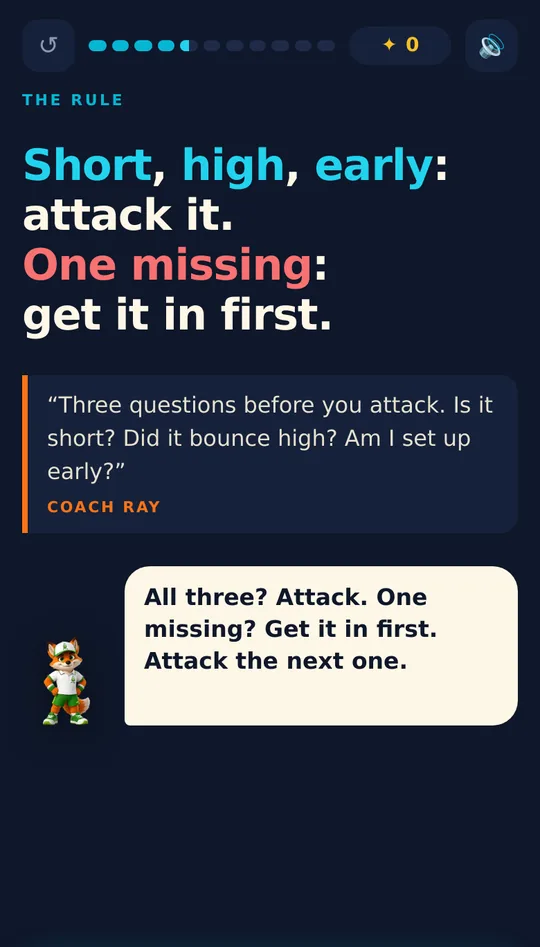
Changing direction means hitting down the line after a cross-court rally. It's how players finish points. It's also riskier, so it needs the right ball. Our lessons teach three questions:
- Is it short? It landed close to the net, inside the service line.
- Is it high? It bounced up higher than the net.
- Am I early? Your child is already behind the ball, with time to swing.
Three yeses: change direction and attack the big empty space. One no: get it in first, deep, and attack the next one.
One trap to know: a high ball that lands deep, near the baseline, is not an attack ball, even if your child is early. Hitting down from way behind the baseline usually ends in the net. Play it back deep and wait for the short one.
5. Get back to the middle
After every shot, your child moves back to a spot where they can reach the next ball. For beginners the rule is simple: back to the middle of the baseline. Advanced players learn the full version later. They stand a little off the middle, toward the side the opponent's diagonal shot would come. Both are right for their level. The first is a step on the way to the second.
6. Do more of what works
The best plan is the one that's winning points today. Teach your child to notice which points they win, and to do more of that.
A practice drill: cross-court until short
This drill turns ideas 2 and 4 into a game. It needs two players, a court, a basket of balls and a parent or coach to start each point.
Setup: Both players stand behind the baseline on the right half of the court as they face the net (the "deuce side"). For two right-handers, this is the forehand diagonal. Every rally ball must land in the half of the court diagonally across from the hitter.
How to play:
- The parent or coach starts each point with an easy ball, to the two players in turn.
- Rally cross-court only. Count the shots out loud. Try to reach 6 before anyone changes direction.
- A player may hit down the line only on a ball that landed inside their service line, bounced high, and that they reached early. After that, play the point out on the whole singles court.
- Changing direction on any other ball loses the point, even if it lands in.
- Play first to 7 points. Then move to the left half of the court (the backhand diagonal for right-handers) and play first to 7 again. Do two rounds of each, about 20 minutes in all.
If one player is left-handed, the diagonals change: one player's forehand diagonal is the other player's backhand diagonal. Play both halves anyway.
What to watch for: whether your child waits for the short ball, or goes down the line because they're bored. The rule is the point of the drill, not the score.
Questions parents ask
Should my child aim for the lines?
No. The line is the smallest target on the court, so aiming there turns small misses into lost points. Aim for the big empty space inside the lines. When a ball lands near the line, it should be because the space was there, not because the line was the target.
Is going down the line a bad shot?
No, it's a good shot for the right ball. Down the line crosses a higher part of the net and has less court, so it's riskier in a long rally. Use it on a ball that's short and high when your child is there early, or to finish a point the cross-court ball set up.
What if the opponent always stands in the middle?
Then there's space on both sides, and the job is to make them use their legs. Keep the ball deep, move them side to side, and wait for the short, high ball. Deep, steady balls make the opponent work. Soft balls give them easy chances.
Does this work in doubles?
Partly. Hitting to space still works, but doubles has its own patterns. In doubles, aim down the middle between the two players: both may leave it for the other. That's a lesson of its own.
Where should my child go after attacking a short ball?
That's an advanced topic. Players who are ready to move forward to the net usually hit that attacking ball down the line. They go cross-court only if that side is wide open, or if the opponent has a clearly weaker side. Beginners don't need this yet. They should learn to win the rally from the back first.