
Learn · for parents
Tennis rules kids (and parents) often get wrong

Coach ArthurHead Pro, Concord Tennis Academy · Toronto, Canada · 20+ years coaching · 7 min read
In my experience, kids most often get these rules wrong: the ball hitting them, touching the net, a serve that clips the net, the net post, and who serves in a tiebreak. Here are nine of them. For each one you get what kids usually think, what the official rule says, and the rule number so you can check it yourself.
Every answer comes from the ITF Rules of Tennis, the rule book used around the world. You can read it free on the ITF website; the link is at the end of this page. Tournaments can add their own rules, such as shorter match formats, so check the event's rules too.
1. "It was going out, so it's my point"
The rule: If the ball touches a player, or anything they're wearing or carrying except the racket, before it bounces, that player loses the point (Rule 24(i)). It doesn't matter where the ball was heading or where the player was standing.
Catching the ball counts too. The ITF rule book gives this exact example. A player standing outside the court catches the ball, or hits it before it bounces. They claim the point because it was clearly going out. They lose the point. The only exception is if they hit it and their shot goes back over the net and lands in. Then play goes on.
What to teach: if a ball is flying out, get out of its way and let it land.
2. "The serve touched the net, so it's a fault"
The rule: A serve that touches the net and then lands in the correct box is a let. The server serves that one again (Rule 22).
Two details catch people out:
- A let doesn't cancel an earlier fault. If the first serve was a fault and the second serve is a let, the server still has only one serve left (Rule 22).
- If the serve clips the net and then hits the receiver before it bounces, that's also a let (Rule 22(a)). But if a serve hits the receiver without touching the net, the server wins the point (Rule 24, Case 7).
3. "I can touch the net after I hit a winner"
The rule: A player loses the point if their body, racket or clothes touch any part of the net or its posts, or the other side of the court, while the ball is in play (Rule 24(g)).
The ball stays in play until the point is decided (Rule 11). Say your child hits a great shot and runs in. If they touch the net before that ball has bounced twice or hit the fence, the point goes to the other player. Winner or not.
4. When the ball hits the net post
This one depends on the court.
- Most club courts, with no singles sticks: during a rally, a ball that hits the net post and then lands in the correct court is good (Rule 25(a)). The same is true in doubles.
- When singles sticks are in place (small poles that hold the net up at the singles line during a singles match): the outer posts, and the part of the net outside the sticks, don't count as the net. The rules treat them like the fence (Rule 2). A ball that hits them before it bounces loses the point for the player who hit it (Rule 13).
- On a serve: a serve that hits a net post or a singles stick before it bounces is a fault (Rule 19(c)).
5. "You have to hit it over the net"
Not quite. A ball can go around the outside of the net post, even lower than the top of the net. If it lands in the correct court, it's good (Rule 25(c)). It's rare, and it's one of the best shots in tennis.
6. "A ball on the line is out"
A ball that touches any part of the line is in (Rule 12). Even a tiny touch of the line counts. That's also why your child shouldn't aim at the line: aim for the big space inside it.
7. "Two touches is always illegal"
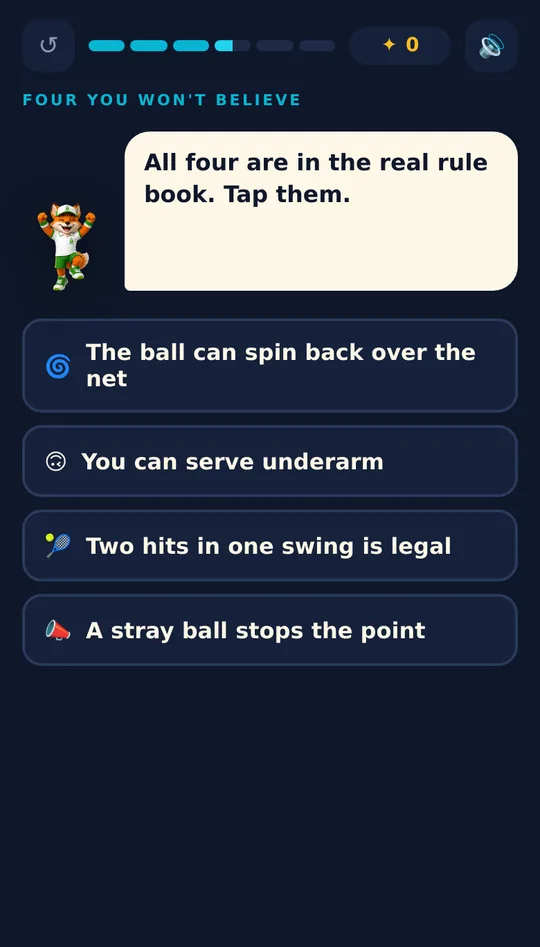
Only if it's on purpose. A player loses the point for deliberately carrying the ball on the racket, or deliberately hitting it twice (Rule 24(f)). If the ball hits the racket twice by accident in one swing, play goes on. The ITF rule book also says an accidental double hit isn't a "hindrance" (Rule 26, Case 1).
8. Reaching over the net
Two different rules:
- The racket may follow through over the net after hitting the ball on your own side (Rule 25(e)).
- Hitting the ball before it has come over the net to your side loses the point (Rule 24(h)).
There's one rare exception. If the ball bounces on your side and the wind or spin carries it back over the net, your child may reach over and hit it. They still must not touch the net or the other side of the court (Rule 25(b)).
9. The tiebreak serving order
In my experience, this causes more arguments in junior matches than any other rule. Here is how a tiebreak works (Rule 5(b), Rule 10 and Rule 17):
- The player whose turn it is to serve serves the first point, from the right side.
- The opponent then serves the next two points: first from the left, then from the right.
- After that, the players take turns serving two points each, always left side first, then right.
- The players change ends after every six points.
- The first to 7 points, with a lead of 2 points, wins the tiebreak and the set.
- In the next set, the player who served first in the tiebreak receives first.
| Point | Server | Side | Change ends after? |
|---|---|---|---|
| 1 | Player A | Right | |
| 2 | Player B | Left | |
| 3 | Player B | Right | |
| 4 | Player A | Left | |
| 5 | Player A | Right | |
| 6 | Player B | Left | Yes, after point 6 |
| 7 | Player B | Right | |
| 8 | Player A | Left | |
| 9 | Player A | Right | |
| 10 | Player B | Left | |
| 11 | Player B | Right | |
| 12 | Player A | Left | Yes, after point 12 |
A simple trick: add up the points played so far. If the total is odd, the other player serves next. If the total is 6, 12 or 18, change ends.
Many junior events play a 10-point "match tiebreak" instead of a third set. The serving order is the same, but the first to 10 points, with a lead of 2, wins the match (Appendix VI).
A quiz for the dinner table
Read each heading in quotes above out loud, like "A ball on the line is out". Your child says "true" or "false" and gives the reason. Then try the five below.
Questions parents ask
Is a let serve the same as a fault?
No. A let is replayed and doesn't count either way. A fault counts as one of the server's two serves. A let also doesn't cancel an earlier fault (Rule 22).
Can my child serve underarm?
Yes. The rules say the server releases the ball by hand and hits it before it touches the ground (Rule 16). Nothing in that rule requires an overarm swing. Some players think it's bad manners, but the rules allow it.
What if the ball hits a player standing behind the baseline?
The same as anywhere else. If the ball touches a player before it bounces, that player loses the point (Rule 24(i)).
Can my child touch the net after the point is over?
Yes. The rule about touching the net only applies while the ball is in play (Rule 24(g)), and the ball stays in play until the point is decided (Rule 11).
Who wins the point if the ball hits the fence?
If the ball lands in the correct court first and then hits the fence, the player who hit it wins the point. If it hits the fence before it bounces, the player who hit it loses the point (Rule 13).
Who serves first after a tiebreak set?
The player who served first in the tiebreak receives first in the next set (Rule 5(b)).
Read the rules yourself: ITF Rules of Tennis (PDF)