
Learn · for parents
How to help your junior player stay calm under pressure

Coach ArthurHead Pro, Concord Tennis Academy · Toronto, Canada · 20+ years coaching · 7 min read
Give your child one short routine for between points. Practice one slow breath at home: in for 4, out for 6. Keep your own words before and after matches short and calm. The nerves won't go away, but the routine stops the nerves from choosing the shots.
I often tell players that a match can be won or lost in the short break between points. Under the ITF Rules of Tennis, that break is at most 25 seconds. That's the part I'd help your child practice.
What pressure does to a young player
Feeling nervous just means the match matters to your child. Feeling angry after a miss means they expect better from themselves. Neither feeling is a problem. What they do next is what counts.
Our lessons teach kids to notice four signals when a point gets big:
- the heart beats faster,
- the hands get tight or shaky,
- the thoughts start racing,
- the legs feel heavy and the feet slow down.
None of them means your child is about to lose the point. But pressure can push a player two ways. Some rush. They swing faster and harder, and the ball flies long. Others freeze. They push the ball short and safe, and the opponent steps in and hits it where they aren't. Both kids have the same strokes. Pressure made one rush and the other freeze.
The miss chain, and how to break it
It starts with one ordinary miss. A feeling comes, and that part is normal. Then the brain says "fix it now!", so the player goes for a bigger shot. A big shot hit in a hurry usually misses too. A few points later, the player isn't really playing tennis any more.
A miss costs one point. The chain after it can cost three or four. So the skill to train is what your child does right after a miss.
The between-point routine, step by step
This is the routine I teach my own players. It's the same every time, after good points and bad ones.
- Walk toward the fence behind you, facing away from the net.
- Fix your strings for about 5 seconds. Look at them and straighten them.
- Take one deep breath: in for 4, out for 6.
- Turn around and face the court.
- Take another breath right before the point starts. A normal one is fine.
- Pick one target for the first ball. "Serve to the backhand." "Return deep through the middle." One spot, nothing else.
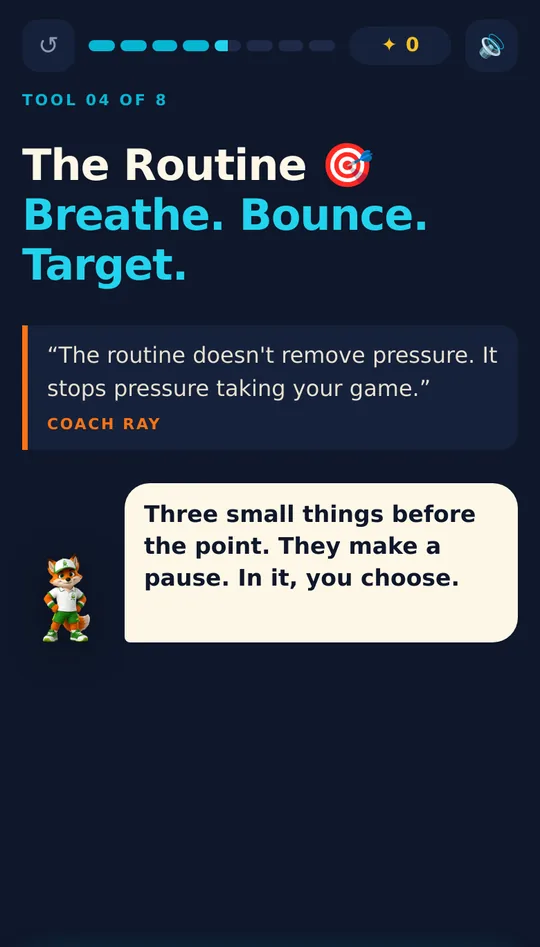
Time it at home with a phone. It should fit well inside 25 seconds. The routine doesn't remove pressure. It makes a pause, and in that pause your child gets to choose instead of react.
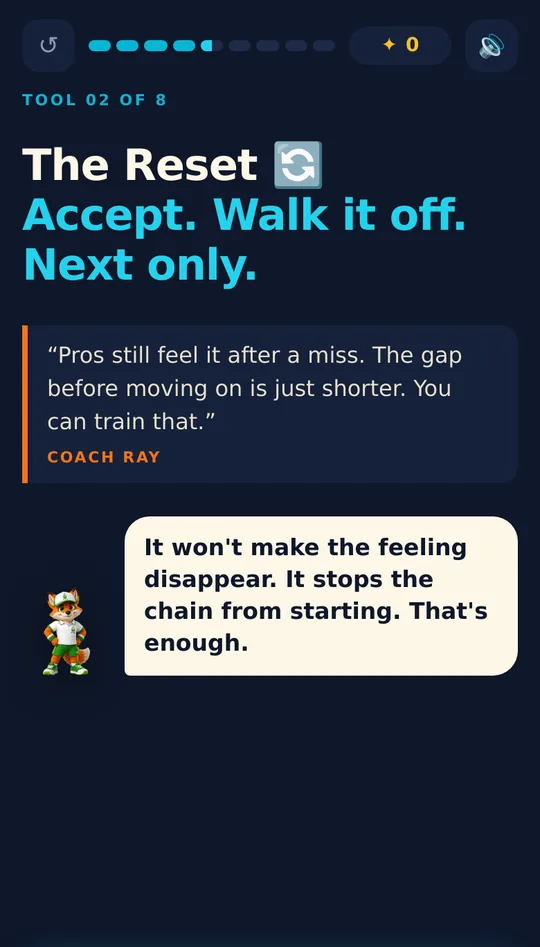
After a miss: accept, walk it off, next only
When the last point was a bad miss, the routine has three jobs. Our lessons call it The Reset.
- Accept. Your child says a short phrase that lets the miss be done. Kids in our lessons choose from "That's tennis", "It happens", "Move on" or "Next point". Let your child pick the one that sounds like them.
- Walk it off. That's steps 1 to 4 of the routine.
- Next only. Step 6: one target for the next ball. Not the miss.
Next time a pro match is on TV, look for the "unforced errors" number on the screen. Even the best players miss easy shots in every match. What they do next is the part that can be trained.
Before a big serve: breathe, bounce, target
On a big point, before serving, your child takes one slow breath. Then they bounce the ball slowly a few times, slower than feels natural. Then they pick the spot. On serve points, this takes the place of steps 5 and 6.
Practice the breath at home first
A breath your child has never practiced won't be there on the biggest point of the match. Practice it when nothing is at stake.
At home, once a day for a week: sit down, breathe in while counting slowly to 4, then breathe out while counting to 6. Do 5 breaths. It takes about a minute.
At practice: one breath before every serve and every return, on good points and bad ones. If they use it on easy points, it will be there on hard ones.
What to say before, during and after a match
Most of these talks happen in the car. Here are the words I'd use. Change them to sound like you, but keep them short.
| When | Say this | Not this |
|---|---|---|
| Before the match | "Have fun out there. I love watching you play." | "You should beat this kid easily." |
| Before the match | "What's your routine between points?" | "Don't get nervous this time." |
| During the match | A clap. Nothing else. | Advice called out from the side, every point. |
| During the match | A calm face after a lost point. | Head in hands, or a sigh they can see. |
| Right after a loss | "I loved watching you play. Do you want to talk about it now or later?" | "Why did you keep missing?" |
| Right after a loss | Quiet, and a snack. | "If you'd just done what your coach said..." |
| Later, when they bring it up | "What's one thing you'd do differently next time?" | "Here are the five things you did wrong." |
| After a win | "What did you do in the tight moments that worked?" | "See? You're better than her." |
Agree on the clap before the match. In one of our lessons, a player asks their dad after a match, calmly: "I love that you come. Could you just clap?" You can offer it before your child has to ask.
After the match, one calm sentence. Then let your child lead. If they want to talk, listen more than you speak. If they don't, wait.
Questions parents ask
My child gets angry after missing. Is that a problem?
The feeling isn't the problem. Anger after a miss usually means your child expects better from themselves. What matters is what comes next. If the anger turns into rushed, bigger shots, teach The Reset: accept, walk it off, next only.
Should my child look at me between points?
It's better if they don't. Looking up at a parent after every miss takes their attention off the court, and the next ball comes anyway. Between points, their eyes go to their strings, then to their target. Agree before the match that you'll just clap.
The opponent keeps making bad line calls. What should I do?
Don't step in yourself. A parent or coach can't help during the match unless that tournament's rules allow it. Only an official can. Check the event's rules before the day. If your child thinks the in-or-out calls keep going wrong, they can calmly ask for an official, then go back to their routine.
How long before the routine works?
Use it on every point at practice for two weeks before a match. The goal is to play well while nervous, not to stop feeling nervous.
Should I talk about the match in the car?
Only if your child wants to. Ask once: "Now or later?" Then follow their answer. One kind sentence and a snack is a good car ride.