Learn · for parents
What is tennis IQ, and how to build it (even without a court)

Coach ArthurHead Pro, Concord Tennis Academy · Toronto, Canada · 20+ years coaching · 7 min read
Tennis IQ is how well a player chooses what to do with the ball. Where does it go? How high over the net? How hard? When? A player with high tennis IQ picks the right shot more often, even if someone else hits harder.
On the first day, I tell every family that tennis is a game of choices. The strongest and fastest kids don't always win. The ones who choose well often do.
The four choices in every shot
Every ball your child hits is four decisions at once. In our app, a coach character called Coach Ray teaches them with four cards:
| The choice | The question your child answers |
|---|---|
| Direction | Where is it going? |
| Height | How high over the net? |
| Pace | How hard? |
| Timing | Early or late? |
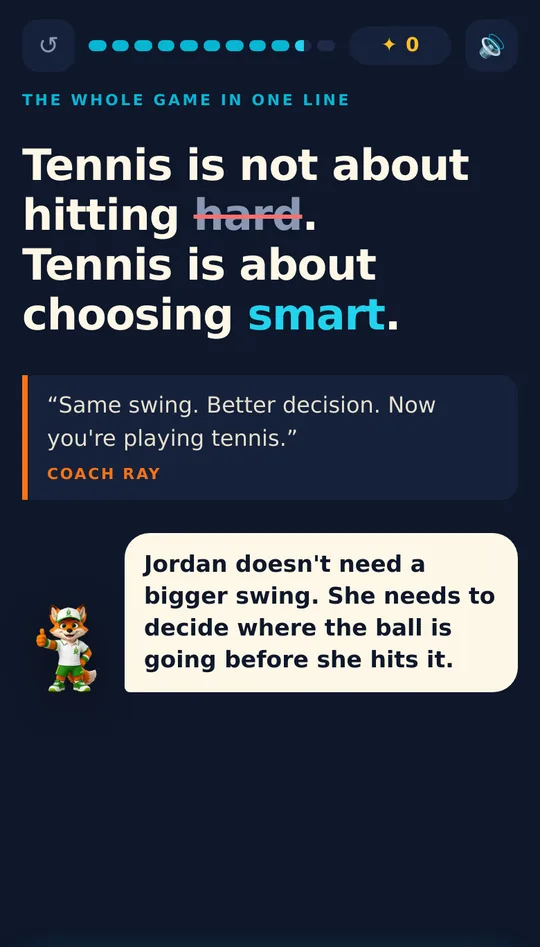
In my experience, most young players think about only one of these: how hard they hit. When things go wrong, they hit harder. The players who improve fastest start thinking about the other three, and direction first.
Why choices beat power
Most points end with a mistake, not a winner. You can check this yourself with the counting game further down. So the first job is simple: keep the ball in play. Make the other player hit one more ball.
Direction is the second job. A ball hit straight at the opponent is easy to return, even a hard one. A softer ball to the empty side makes them run, and a running player has less time to choose a good shot. Our article on where to hit in singles shows this on a court.
What tennis IQ looks like in a match
You don't need to know tennis to spot it. Watch your child play for about 30 minutes and look for these five things.
- They look before they hit. Between points they check where the opponent is standing.
- They hit to space, not to the person. Count how many balls go straight back to the opponent. Fewer is better.
- They wait for the right ball to attack. Our lessons teach three questions first. Is the ball short? Did it bounce high? Am I there early? Three yeses: attack. One no: get it in first and attack the next one.
- They change one thing when something isn't working. If they lose points the same way twice, a smart player changes one thing. Not five things, one.
- They get back to the middle after each shot. Beginners go back to the middle of the baseline (the back line of the court). Advanced players learn the full version later: they stand a little off the middle, toward the side the opponent's diagonal shot would come.
Five ways to build tennis IQ at home
None of these needs a court, a racket or a ball. Most take ten minutes or less. Do one or two a week.
1. Count how points end
Find a match to watch. A junior or club match is best if you can find one online. Take a sheet of paper and draw three columns: Winner, Forced mistake, Easy mistake.
- Winner: the other player never touched the ball.
- Forced mistake: the player missed because the other player's shot was hard to return.
- Easy mistake: an ordinary ball, and they missed anyway.
Watch 20 points together and put one tick in a column for each point. Then add the two mistake columns together and compare them with the winners. Ask your child what that means for their own matches, and let them answer in their own words.
2. Pause and predict
Use a recorded match. When a player is about to hit, press pause. Your child points to the open space on the other side and gives one reason. Then press play and see what the player did.
Do ten pauses. Give a point for any answer with a good reason, even if the player chose something else. The reason matters more than the guess.
3. The car quiz
This one is for the drive to practice. You describe a ball, and your child says what to do with it. Start with these six:
| You say | A good answer |
|---|---|
| "Short ball. It bounced high. You got there early." | Attack it, into the big empty space. |
| "Short ball. It stayed low. You got there late." | Get it over the net and in, deep. |
| "High bounce, you're early, but it landed near the baseline." | Get it back in deep, and wait for a short one. |
| "Your opponent is standing on your left." | Aim at the space on your right. |
| "You lost two points in a row the same way." | Change one thing. |
| "You just missed an easy shot." | Accept it, walk it off, think only about the next ball. |
4. One question after every match
After a match, win or lose, ask one question: "What's one thing you'd do differently next time?" Then stop. Don't add your own list. Write the answer down somewhere. After a month, read the list together.
5. Rehearse the four steps before a point
In our first Tennis Thinking lesson, the smart player does four things before every point: pause, look where the opponent is, choose a spot, swing. These four steps are also the last part of the between-point routine in our article on staying calm under pressure.
Your child can rehearse them in the living room. You say "point!" and they act out the four steps in a few seconds. Do ten. It feels silly the first time, and that's fine.
How you'll know it's working
You'll hear it before you see it. Your child starts explaining points after a match: "She kept going to my backhand, so I moved over a bit." That's tennis IQ talking. Over time, the player becomes their own coach on the court.
Questions parents ask
Is tennis IQ something kids are born with?
No. Some kids notice open space sooner than others, but every child can learn to look before they hit. It gets better the same way a forehand does, with practice.
My child hits very hard. Is that bad?
Power isn't the problem. A hard shot to the right place is great. The trouble starts when hitting harder becomes the only plan. If your child misses a lot of big shots, help them think about direction and height first.
Can my child build tennis IQ by watching pros on TV?
Yes, if they watch with a job to do. Just watching helps a little, in my opinion. Counting how points end, or pausing to predict a shot, helps more because your child has to decide something.
How long does it take to see a change?
Use the one-question habit after every match for a month. If the answers get more specific, it's working. "I played badly" turning into "I hit too many balls to her forehand" is real progress.
Do I need to know tennis to help?
No. You only need to ask good questions and listen. "Where was the open space?" and "What's one thing you'd change?" work even if you've never held a racket.